Connected Garden 2026: The Complete Guide to Total Automation
By Le Coin Vert
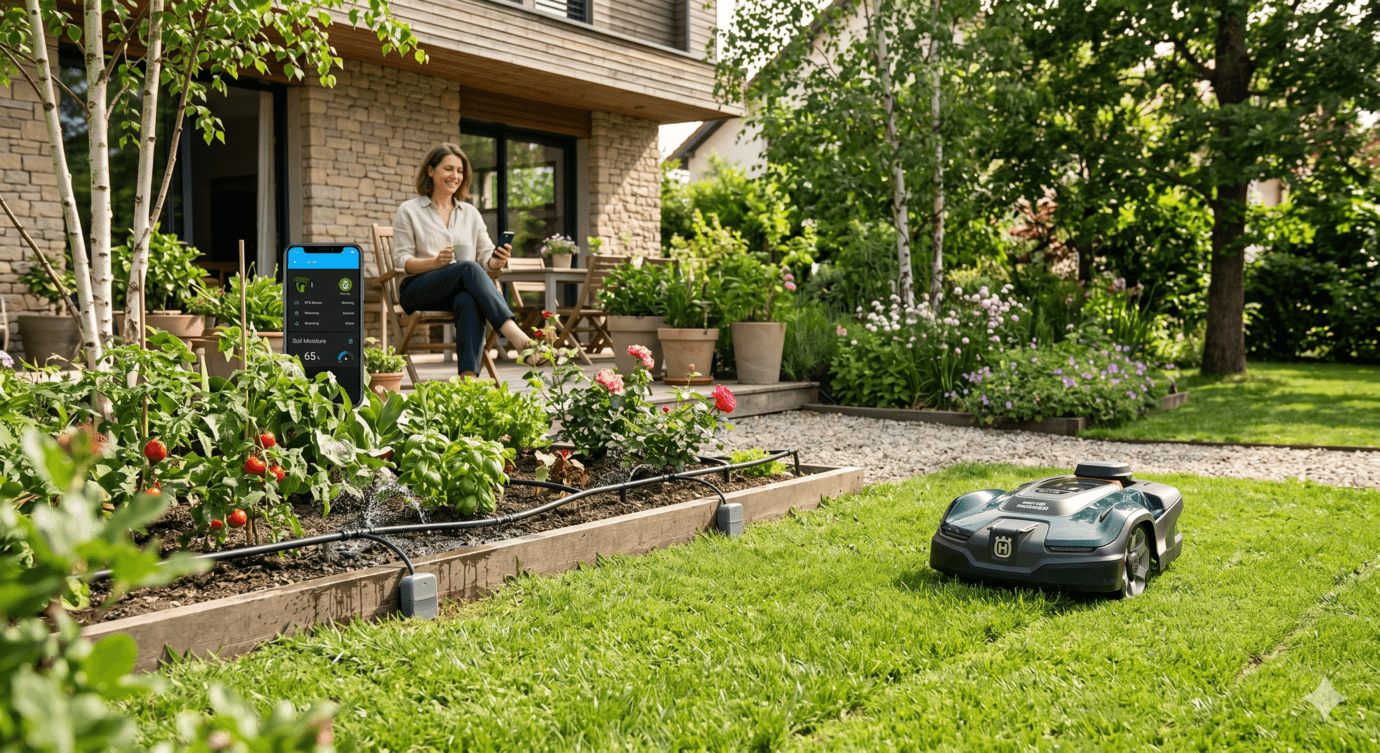
Welcome to Le Coin Vert! If you are reading these lines, you likely share my observation: having a beautiful garden is a joy, but maintaining it can quickly turn into a second job. Between the weekly mowing that devours your Saturday afternoons and the haphazard management of watering during summer heatwaves, the equation becomes complex.
Fortunately, in 2026, technology has reached exceptional maturity. No more capricious gadgets; today we are talking about true domestic assistants capable of managing your green space autonomously, ecologically, and economically.
In this complete guide, we will break down the solutions for automating your outdoors together. Whether you have a small city garden or a vast steep terrain, get ready to take back control of your free time.
1. The Autonomous Mowing Revolution: Should you cut the cord?
The first pain for a garden owner is undoubtedly mowing. Historically, installing a robot mower required burying a boundary wire all around the terrain. A tedious task, prone to breaks (the famous unfortunate spade strike) and limiting modifications to your garden. Today, the market is divided between wired models, which remain excellent value for money, and the new monsters of wireless technology.
Note: Don't let yourself be blinded by novelty. If your terrain is very simple (square, flat, without trees), a cable model will cost you much less for an identical result on the lawn. Wireless technology shows its true value on complex or constantly evolving terrain.
A. Wireless technologies decrypted (RTK, LiDAR, Vision)
Abandoning the cable has been made possible by three major technologies, each responding to specific problems.
1. GPS RTK (Real Time Kinematic)
This is the flagship technology. It uses classic satellites coupled with a reference antenna placed in your garden to obtain centimeter precision.
The ideal investment for... Clear terrains up to 2000m². The Segway Navimow i105E (500m²) is currently our favorite in this category, offering mapping by app of childish simplicity.
2. LiDAR (Laser remote sensing)
If your terrain has very large deciduous trees that block the sky, GPS RTK will fail. LiDAR, on the other hand, 3D maps its direct environment, just like high-end robot vacuums do.
Why we recommend this model for difficult terrains: The Dreame A1 Pro LiDAR (2000m²) doesn't care about the GPS signal. It "sees" your garden in 3D, avoids forgotten toys, and manages dense shadow zones with stunning mastery.
3. Camera Vision (IA)
Here, no prior mapping is necessary. The robot recognizes the grass and stops where it stops.
The best choice for... Those who refuse any installation. The Landroid Vision M600 is placed on the lawn, you press Start, and it mows. Simply. For specific needs, the YUKA Mini Vision also offers remarkable performance in this category.
2026 Wireless Robot Comparison
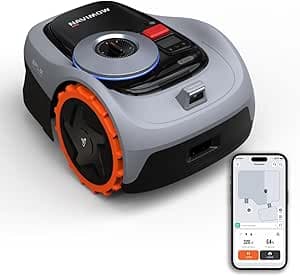 |  | 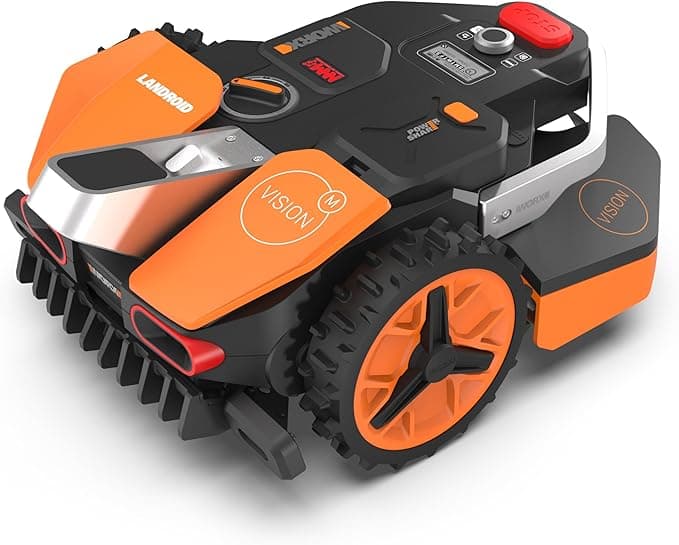 | 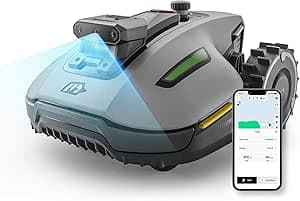 | |
|---|---|---|---|---|
| Max area | 500 m² | 2000 m² | 600 m² | 700 m² |
| Max slope | 30% | 45% | 30% | 45% |
| Wire-free | ||||
| GPS / RTK | ||||
| Cut-to-Edge | ||||
| App control | ||||
| Check price | Check price | Check price | Check price |
B. Let's not neglect the new generation wired models
While wireless technologies shine, boundary wire robots have evolved. They are now hyper-connected, silent, and above all, they are infallible where waves struggle to pass.
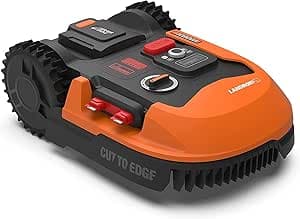
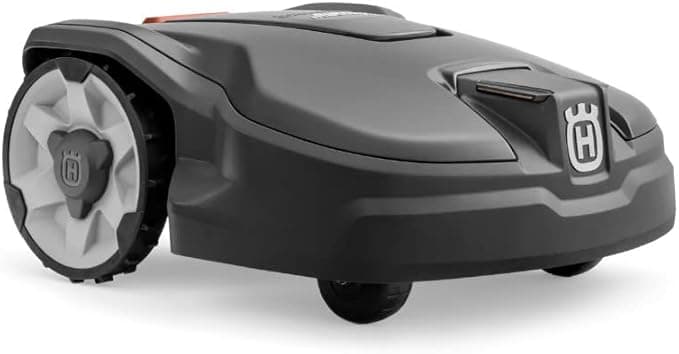
For a complex medium-sized terrain, the Landroid M500 Plus (500-700m²) or its little brother the Landroid S300 (300m²) offer exceptional modularity thanks to their clip-on accessories. If you're looking for historical Swedish reliability for very large areas, the Automower 310 (1000m²) and Automower 315 (1500m²) remain unshakeable safe bets.
2026 Wired Robot Comparison
 |  |  |  | |
|---|---|---|---|---|
| Max area | 300 m² | 700 m² | 1000 m² | 1500 m² |
| Max slope | 35% | 35% | 40% | 40% |
| Wire-free | ||||
| GPS / RTK | ||||
| Cut-to-Edge | ||||
| App control | ||||
| Check price | Check price | Check price | Check price |
C. The nightmare of sloping terrains: The solution
Your garden looks like a red ski slope? Most robots will slip or go into error at the slightest morning dew. This is where specialized war machines come in.
The game changer for slopes up to 80% with all-wheel drive
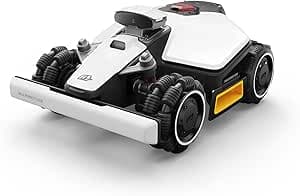
Mammotion LUBA Mini AWD 800
The compact off-roader...
- All-Wheel Drive (AWD) perfect for rough terrain
- handles slopes up to 80%
- aesthetic straight-line mowing.
- Bulky design
- the companion app can sometimes lack intuitiveness.
Affiliate link. Same price for you.
⚠️ Pay attention to the choice of tires! If your terrain is wet and sloping, even an excellent robot will need specific spiked wheels (often sold as an option) to avoid tearing up the turf.
2. Smart Watering: Save your plants, your wallet, and the planet
If automating mowing is a question of comfort, automating watering is a question of survival for your plants and ecological responsibility. Watering at fixed times every day, whether it rained the day before or not, is a practice of the past.
A. "Tap-end" connected timers
Watering automation starts simply. By replacing your old dial timer with a connected valve, you open the door to artificial intelligence.
- The Apple / Thread ecosystem: The best choice for iPhone users is undoubtedly the Eve Aqua (HomeKit/Thread). It uses the Thread protocol (fast, energy-efficient, and meshed) and integrates perfectly with Apple's Home app.
- The Gardening reference: If you already own Gardena equipment, the Gardena Smart Water Control integrates into a proven ecosystem, although operating on a gateway.
Eve Aqua Gen3 (HomeKit / Thread)
Pros
- Native and fluid HomeKit integration
- Ultra-fast and energy-efficient Thread protocol
- Installation in less than 5 minutes
- Compatible with Siri / Shortcuts voice control
- Automatic schedule updates based on weather
Cons
- Reserved for Apple ecosystem
B. The sinew of war: Sensors
A connected timer without sensors is like a car without a dashboard. For watering to become intelligent, it needs data.
1. Weather stations
Rather than relying on national forecasts (often inaccurate at the scale of your neighborhood), install a Netatmo Weather Station. It measures temperature, humidity, and above all, via its anemometer and rain gauge (sold separately), the exact amount of water that fell on your lawn.
2. Soil probes (The pro approach)
The Holy Grail of watering consists of measuring moisture directly at the roots. The Ecowitt GW1100 gateway allows you to associate dozens of inexpensive soil moisture probes. If the earth is already wet at 15 cm deep, the system will cancel the planned watering cycle, even in the middle of a heatwave.
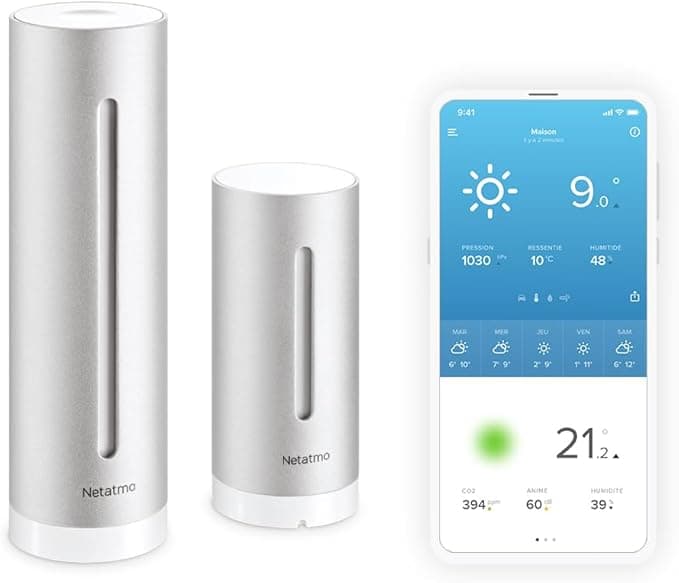
Netatmo Smart Weather Station
Netatmo Smart Weather Station...
- Measures indoor air quality (CO2)
- clean app with excellent data history, aluminum design.
- Outdoor module must not be exposed to direct rain or sunlight (skews temperatures), no display on the station itself.
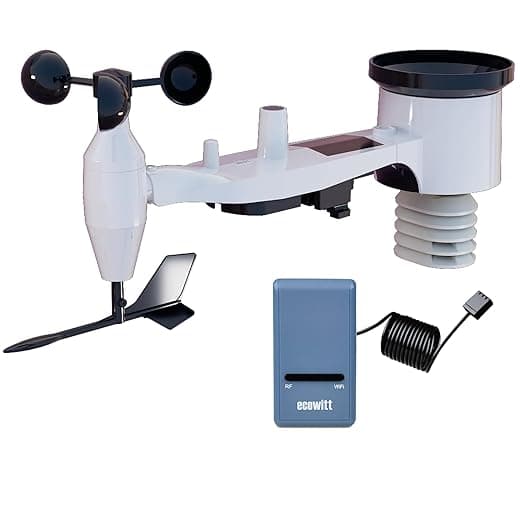
Ecowitt GW1100 Wi-Fi Gateway
Ecowitt GW1100 Wi-Fi Gateway...
- Very budget-friendly solution, expandable with many sensors (soil moisture, rain gauges), easy access to local data.
- Web administration interface is a bit technical, basic plastic design.
3. Advanced Level: Creating the Global Home Automation Ecosystem (Home Assistant)
This is where the magic happens. Having one app for the robot mower and another for watering is fine. Making all these devices communicate together autonomously is the true goal of the connected garden.
By using a home automation supervisor like Home Assistant, you can create powerful synergies.
Practical case of smart automation
Imagine the scene: Your Netatmo station detects strong wind gusts and a sudden drop in atmospheric pressure announcing a violent storm.
Step-by-step guide
- 1
Step 1: Watering cancellation
The planned watering for 5:00 AM is automatically deleted to avoid over-saturating the soil.
- 2
Step 2: Shelter mode
Your robot mower receives the order to return to its station immediately to avoid hail or branch falls.
- 3
Step 3: Safety lighting
Your terrace lights turn on automatically to secure the surroundings during the storm.
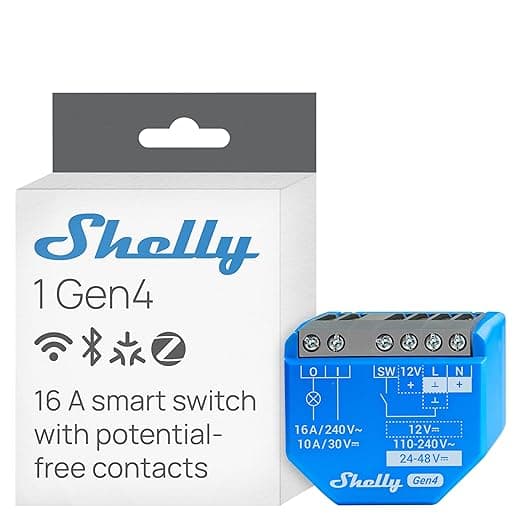
Shelly Plus 1
The Wi-Fi relay micromodule...
- Ultra-compact size fits behind switches, built-in Wi-Fi and Bluetooth, allows low-cost automation of outdoor lights or pumps.
- Requires handling electrical wiring (safety standards apply), initial setup can be complex for beginners.
Here is what a basic YAML automation in Home Assistant looks like to suspend watering if it has rained or if the soil is wet:
unknown nodeThis automation illustrates the power of the unified approach: a single system orchestrates mowing, watering, and lighting based on the real conditions of your garden.
Not sure which equipment to choose?
Our simulator guides you to the ideal solution based on your terrain, your budget, and your constraints.
Read also
.png&w=3840&q=75)
May 10, 2026
Nighttime Smart Home Scenarios: Linking Mowing, Lighting and Weather
Your robot starts at 11 PM because rain is forecast tomorrow. The garden lights activate at sunset and cut off when it docks. This level of automation works today with Home Assistant.
Apr 6, 2026
Home Assistant Green Review: The Official Smart Home Hub
Discover our review of the Home Assistant Green. The official hub to start in smart home without technical skills. Installation, performance, and expert opinion.
.png&w=3840&q=75)
Apr 5, 2026
Improving Wi-Fi Coverage for a Flawless Connected Garden
Is your robot mower stopping in the middle of the yard? Discover our expert guide to diagnose and extend your garden's Wi-Fi range.