Small Urban Gardens: Which Wire-Free Robot Mower to Choose in 2026?
By Le Coin Vert
.png&w=3840&q=75)
The standard pitch for robot mowers assumes a spacious suburban lawn with clear sightlines and reliable GPS. Most urban gardens in France and the UK look nothing like that. Walls two metres high on three sides, a shed blocking the fourth, decorative tiles reducing the actual grass to a strip 40 cm wide. For this kind of garden, picking the wrong model means a robot that either refuses to map the space or circles the same corner for 20 minutes per session.
Why RTK Fails in Walled Urban Gardens
RTK (Real-Time Kinematic) GPS is the navigation technology used by most premium wire-free robots. It needs a continuous, clean signal from several satellites simultaneously. A clear suburban garden delivers exactly that. A courtyard surrounded by two-storey walls does not. The walls create a narrow sky corridor, satellites drop in and out, and the RTK fix degrades to the point where the mower loses positioning entirely. In practice, RTK robots in hemmed-in urban gardens will either refuse to start a session or produce erratic mowing paths that leave unmown patches along the perimeter.
This is not a minor inconvenience. It is a fundamental incompatibility between the navigation method and the environment.
RTK, Vision or LiDAR: Which Technology for Your Walled Garden?
Three navigation technologies are now available across wire-free robot mowers. They suit different environments, and urban gardens call for specific ones.
RTK GPS works well when the sky is open. If your garden has a sky view angle above roughly 120 degrees, RTK will work fine. If walls, trees, or structures reduce that angle significantly, signal degradation makes RTK unreliable.
LiDAR builds a 360-degree point cloud of the garden and navigates by matching that map in real time. It is completely independent of GPS signals, which makes it excellent in enclosed gardens. The one limitation: LiDAR beams reflect poorly off glass surfaces (a glass greenhouse or conservatory extension can create blind spots). If your garden does not contain glass structures, LiDAR is the most reliable choice for walled urban spaces.
Vision cameras use AI image recognition to identify the garden boundary, obstacles, and lawn edges. They handle dynamic obstacles (a child crossing the lawn, a cat sleeping on the grass) in real time, something neither RTK nor LiDAR can match. Vision robots tend to work well in small, complex gardens because the narrow space gives the camera enough reference points to stay oriented.
For most urban gardens, LiDAR or Vision gives you reliable, GPS-independent operation that RTK cannot provide.
Not sure which navigation tech suits your garden?
Answer 6 questions and get a personalised recommendation.
The Space Problem: Minimum Areas and Narrow Corridors
Wire-free robot mowers have a minimum lawn area requirement, typically around 50 m². Below that, the robot cannot complete a meaningful mapping pass and the per-session efficiency drops dramatically. If your actual grass area is smaller, a manual push mower or a corded rotary is still faster and cheaper.
Above 50 m², the critical variable is corridor width. Wire-free robots navigate by building maps, and they need to physically pass through every zone to map it. A corridor narrower than 60 cm becomes impassable for most models. If a garden has islands of grass separated by paving strips, each island needs its own session, and some models cannot handle multi-zone gardens without manual repositioning.
The Segway Navimow i105E handles plots between 100 m² and 500 m² with GNSS+VSLAM, a hybrid approach combining satellite positioning with visual landmark tracking. In enclosed gardens where pure RTK would fail, the VSLAM component provides local stabilisation. The Mammotion Luba Mini AWD 1500 covers up to 1500 m² with a LiDAR sensor that functions independently of sky access. For gardens under 200 m² where obstacle avoidance matters most, the Dreame A3 AWD Pro 3500's all-wheel drive and vision system make it the most capable option.
Wire-Free Robot Mowers for Urban Gardens 2026
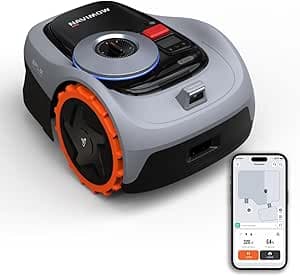 | 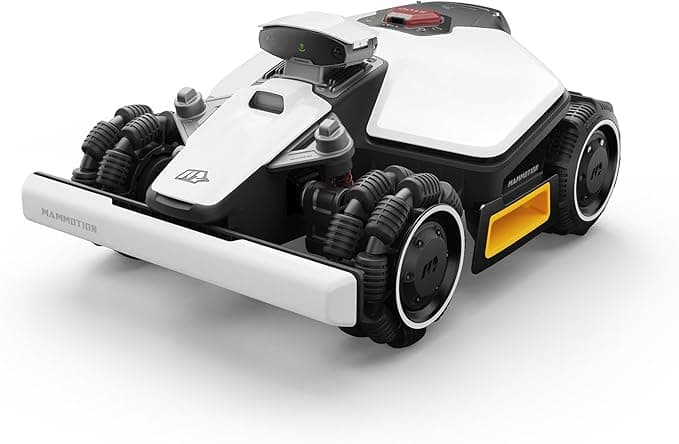 | 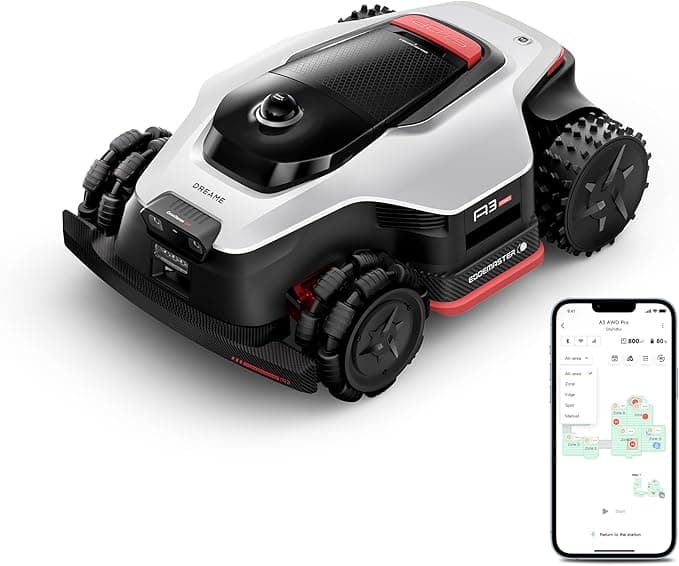 | |
|---|---|---|---|
| Max area | 500 m² | 1500 m² | 3500 m² |
| Max slope | 30% | 80% | 80% |
| Wire-free | |||
| GPS / RTK | |||
| Cut-to-Edge | |||
| App control | |||
| Check price | Check price | Check price |
Slopes, Paving, and Perimeter Complexity
An urban garden is rarely a flat rectangle. Steps, raised beds, a slope down to the patio, a tree in the centre. Each of these creates zones the robot cannot reach without specific capability.
Slopes above 35% require AWD (all-wheel drive). Most standard wire-free robots are two-wheel drive and will slip or stall on anything beyond 25%. If your garden has any slope section above that threshold, an AWD model is not optional.
Tree trunks and low planters require robust obstacle avoidance. RTK robots typically have no obstacle sensor at all, on the assumption of a clear, mapped lawn. LiDAR and Vision robots detect obstacles and route around them. In a garden with multiple fixed obstacles, the mapping quality of the initial pass determines the quality of every subsequent session.
What "Small" Actually Costs to Maintain Well
The total cost of ownership for a wire-free robot in an urban garden is lower than most buyers expect over a three-year period. The initial investment is higher (typically £600 to £1200), but there is no wire to lay, no wire breaks to repair, and no professional installation required. The only recurring cost is blade replacement (typically every 60 to 90 days in season) and the electricity to charge (under £20 per year for a small model).
Against that, the manual mowing cost for a 150 m² urban lawn, done every 10 days through the season, amounts to roughly 20 hours of labour per year. At any reasonable valuation of your time, a wire-free robot pays back its premium within 18 months.
Wire-Free Robot Mowers in Urban Gardens
Pros
- No wire installation required
- Works in walled gardens with LiDAR or Vision
- Handles narrow corridors better than perimeter-wire models
- Automatic obstacle detection on LiDAR and Vision models
Cons
- RTK models unreliable in enclosed spaces
- Minimum 50 m² grass area needed
- Higher upfront cost than wired equivalents
- Glass structures can interfere with LiDAR
Frequently Asked Questions
Can a wire-free robot mower work in a garden surrounded by 2m walls?
What is the minimum lawn size for a wire-free robot mower?
Do wire-free robots handle multiple disconnected grass zones?
Read also
May 5, 2026
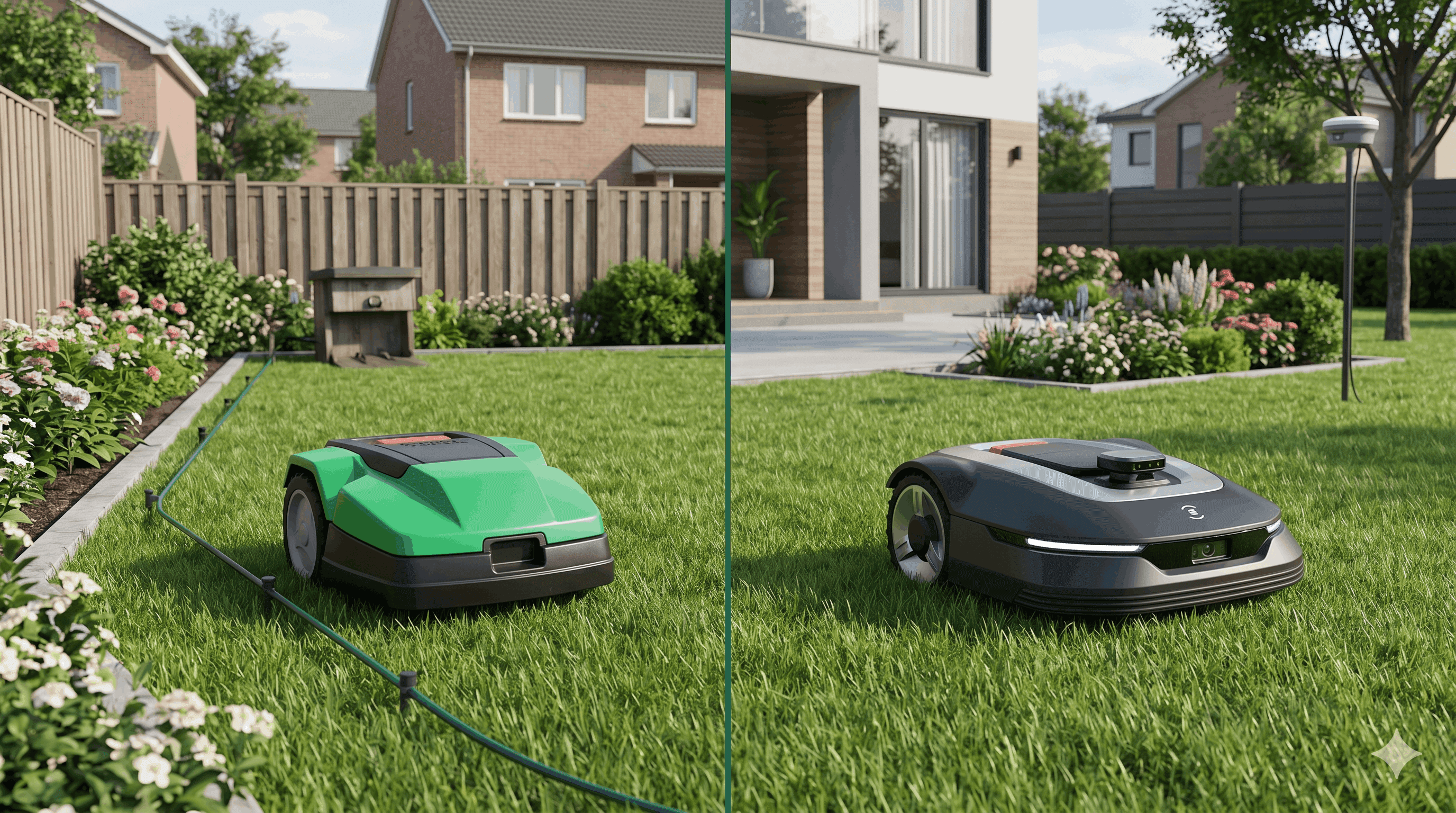
Replacing Your Boundary Wire Robot Mower with a Wire-Free Model: The Transition Guide
The installation took a full weekend and cost 200 euros. Three years later you have repaired the wire four times. Here is how to move to a wire-free model without repeating the same headache.
.png&w=3840&q=75)
May 3, 2026
Winterising and Maintenance: 5 Steps to Double the Lifespan of Your Robot Mower
Most robot mower failures do not happen during the mowing season. They happen after a bad winter storage. Here is how to avoid the most costly mistakes.
Apr 28, 2026
Anti-Theft and Security: How to Protect Your High-End Robot Lawn Mower
A stolen robot mower becomes a useless brick within minutes. Here is how the digital security layer works, what 4G tracking actually does, and what you can add to make theft genuinely pointless.