4x4 Robot Mowers: The Ultimate Guide for Slopes and Sandy Terrain
By Alexandre
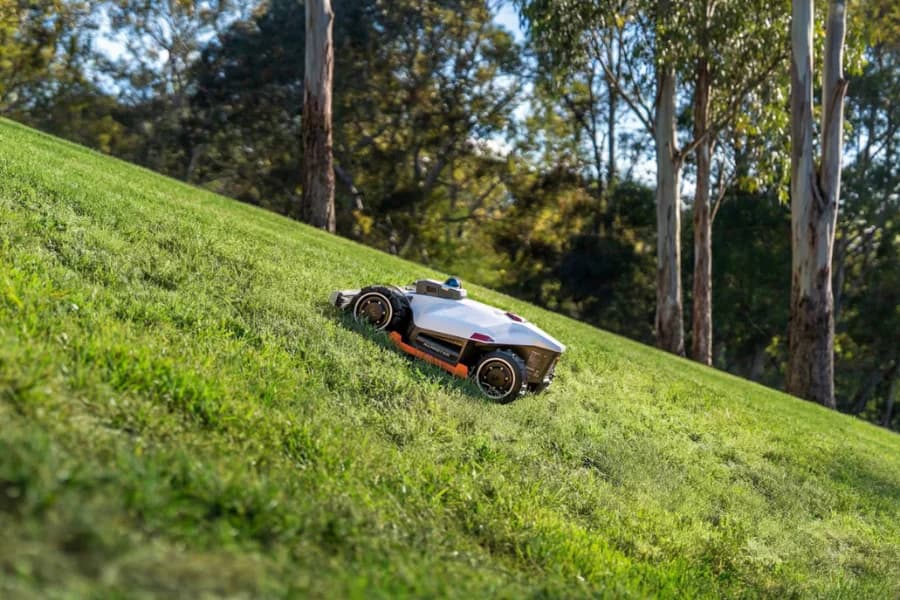
The hell of atypical terrains: when garden home automation finds its limits
If you own hilly terrain, an alpine lawn, or particularly loose and sandy soil, you know this scene by heart. You look out the window, hoping to see a freshly cut lawn, and your robot mower is once again immobilized. It lies in the middle of a slope, its rear wheels digging a crater in the turf, or completely bogged down in a patch of sandy soil. The app displays a perennial error message: "Robot stuck" or "Wheel motor overloaded."
For years, the industry designed machines for perfectly flat suburban gardens. Traditional two-wheel drive (2WD) robot mowers are excellent machines for standard lawns. However, their architecture presents clear physical limits that make their use nightmarish as soon as the terrain gets tough.
Anatomy of a failure: why classic robots hate slopes
To understand the solution, we must first dissect the problem. A classic robot mower is generally propelled by its two rear wheels, while the front wheels (often simple swiveling casters) ensure steering.
The mass transfer problem
When the robot approaches a steep slope uphill, gravity causes a mass transfer to the rear. If the slope is too steep, the front end lightens. The robot loses its ability to steer correctly, the nose lifts slightly, and the rear wheels must provide disproportionate effort.
The physics of sand and loose soils
On sandy or very dry soil, the friction coefficient drops drastically. The lugs of the hard plastic wheels have nothing to grab. One wheel starts to spin. As soon as one wheel spins in a vacuum, the robot pivots on itself, loses its heading, and ends up burying itself. This slippage phenomenon is particularly destructive: not only is your lawn not mown, but the wheels tear the grass out to the root.
Warning: Repeated slippage on a slope can create permanent ruts that will promote runoff and erosion of your terrain.
The all-wheel drive (AWD) revolution
For so-called extreme terrains, DIY fixes (like weighted wheels or a posteriori added metal lugs) are no longer enough. The only real technical and sustainable answer lies in all-wheel drive (AWD).
Pioneering and resolutely high-end models, like the Mowrator S1 or the Husqvarna 435X AWD, have paved the way for this category of extraordinary climbers, redefining what a robot is capable of accomplishing autonomously.
How does an AWD robot mower work?
Unlike a classic 4x4 car that uses a central driveshaft to distribute power, a modern AWD robot mower adopts a much more intelligent and decentralized approach.
Each wheel (or each axle, depending on the model) is equipped with its own independent electric motor. This architecture allows for what engineers call torque vectoring. The onboard computer analyzes the rotation speed and resistance encountered by each wheel dozens of times per second.
- If the front left wheel encounters a soft sand zone: The system detects the loss of traction. It instantly reduces the power sent to this wheel to prevent it from digging and transfers maximum torque to the other three wheels that benefit from a solid base.
- On downhill slopes: Braking is distributed over the four wheels, avoiding the fatal slide that propels the robot out of its work zone or into a flower bed.
The articulated chassis: the secret weapon of traction
Power is nothing without contact with the ground. Many AWD robots have a chassis split into two articulated parts. This flexibility allows the robot to literally "twist" to match terrain irregularities. Even when crossing a large root or a sand pit, all four wheels remain firmly pressed to the ground.
Key criteria for choosing an extreme robot
Before pulling out the credit card for an AWD model, it is crucial to validate certain technical parameters to ensure the machine matches the green hell that is your garden.
1. Understanding the slope rate (Percentage vs. Degrees)
This is the most common error among buyers. Manufacturers generally communicate in percentage (%), not degrees (°). A 100% slope means that for 1 meter traveled horizontally, you go up 1 meter vertically (which corresponds to a 45-degree angle). A standard robot handles about 30% to 40%. An AWD robot must be able to guarantee grip on slopes of 70% to 80%.
2. Tire type
Look closely at the wheels. A true all-terrain robot has soft rubber tires (not hard plastic) with deep treads, often in a herringbone pattern, similar to those of a farm tractor. These chevrons allow loose soil and sand to be evacuated towards the outside of the tire, ensuring self-cleaning that maintains grip.
3. Energy management (Battery and Motors)
Climbing a 70% slope with four active motors requires a colossal amount of energy. Ensure the robot has a high-capacity battery. Moreover, the machine must be able to return to its charging station with sufficient energy reserve, as a breakdown in the middle of a steep slope would require manual towing.
Our absolute recommendation for extreme terrains
In the current catalog, one machine stands out particularly for its climbing capabilities in difficult conditions, while integrating the latest wireless navigation technologies.
The undisputed master of slopes reaching 80% without loss of traction
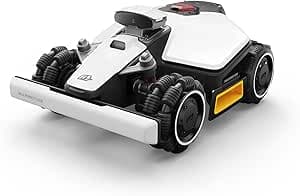
Mammotion LUBA Mini AWD 800
The compact off-roader...
- All-Wheel Drive (AWD) perfect for rough terrain
- handles slopes up to 80%
- aesthetic straight-line mowing.
- Bulky design
- the companion app can sometimes lack intuitiveness.
Affiliate link. Same price for you.
The Luba Mini AWD 800 is a true miniature tank designed specifically for elevation changes. Thanks to its design thought for the extreme, it navigates where almost all robots on the market call it quits. Its ability to face slopes of 80% (nearly 39 degrees of incline) makes it indispensable for terraced gardens, mountain terrain, or properties with steep embankments.
Beyond its stunning all-wheel drive, this model shines with its RTK navigation system, freeing you from the complex laying of a boundary wire on already difficult-to-access terrain.
Luba Mini AWD 800 Analysis
Pros
- Redoubtable all-wheel drive thanks to 4 motors
- Climbs 80% slopes with disconcerting ease
- Wide omnidirectional tires to avoid marking the ground
- Wireless RTK boundary technology
Cons
- Significant weight requiring precautions when carrying
- Imposing size less agile in very small corners
Comparison: All-wheel drive vs. classic traction
To fully understand the performance gap and justify the investment in an AWD machine, it is crucial to compare a 4x4 model with an excellent classic 2WD robot designed for more regular terrain (like the Segway Navimow i105E, perfect for flat ground but limited in traction).
Traction Match: 4x4 All-Wheel vs. Standard Traction
|  | |
|---|---|---|
| Max area | 800 m² | 500 m² |
| Max slope | 80% | 30% |
| Wire-free | ||
| GPS / RTK | ||
| Cut-to-Edge | ||
| App control | ||
| Check price | Check price |
Info: If your terrain does not exceed 30% slope, a high-end 2WD model will remain more economical and perfectly suited.
Practical guide: Preparing difficult terrain for automated mowing
Even with the highest-performing AWD machine on the market, some agronomic adjustments and settings guarantee operation without any human intervention. Here is how to prepare your battlefield.
Step-by-step guide
- 1
Step 1: Drastically raise the cutting height
On sandy or highly uneven areas, start with a high cut, thus preventing the cutting deck from rubbing the ground during tilting, which would block the wheels.
- 2
Step 2: Consolidate the substrate
Fill dry sand craters with a mix of potting soil and hardy seeds to provide an initial grip point for the treaded tires.
- 3
Step 3: Optimize mapping
Use your robot's app to create diagonal approach corridors to your most severe slopes in order to reduce the attack incline percentage.
- 4
Step 4: Avoid mowing in torrential rain
Although AWD models are waterproof, wet grass mixed with loose soil creates slippery mud that reduces even the effectiveness of the best herringbone tires.
Specific maintenance for a 4x4 robot mower
A robot that works hard needs special attention. The mechanical stresses undergone by an AWD model on 80% slopes are incomparable to those of a robot strolling on a golf green.
- Regular cleaning of treads: Sandy terrains tend to clump between the tire lugs, especially with morning dew moisture. If the lugs are clogged, the tire becomes smooth. Cleaning with a low-pressure water jet or a hard brush is recommended every two weeks.
- Checking transmission axles: Sand is a redoubtable abrasive. Ensure that no plant debris mixed with sand wraps around the axles of the four motors, which could force the seals and cause overheating.
- Blade management: Mowing on uneven ground increases the risk of hitting small clumps of dirt or surface roots. Inspect the blades more frequently. Dull blades require more effort from the cutting motors, which reduces the energy available for the traction motors during climbs.
Frequently asked questions about extreme terrains (FAQ)
Frequently Asked Questions
Do AWD robots damage the lawn during U-turns in sand?
Can a 2WD robot with weighted wheels and metal lugs be enough?
Does the battery drain much faster on slopes?
My terrain has 80% slopes, do I necessarily have to use a wireless RTK robot?
What happens if the robot slips despite its 4-wheel drive?
Conclusion: Stop suffering from topographic anxiety
Having atypical terrain, massively sandy, or presenting a steep slope should no longer be a sentence to exhausting and dangerous manual mowing chores. Engineering has made giant leaps in recent years.
By investing in a high-end AWD model, you are not just paying for four motors instead of two. You are buying peace of mind: that of launching a mowing cycle from your workplace and never again finding your precious robot bogged down or in distress in the middle of a steep slope when you get home in the evening.
Automating complex green spaces is now a mastered technical reality. It is time to let the machine do the heavy work.
Does your terrain really require AWD?
Use our free simulator to analyze your garden's slope and get the list of compatible robots in two minutes
Read also
.png&w=3840&q=75)
May 19, 2026
Small Urban Gardens: Which Wire-Free Robot Mower to Choose in 2026?
High walls, narrow paths, and a patio taking up half the garden. Urban lawns are the hardest terrain for robot mowers. Here is which navigation technology actually works when the sky is blocked.
May 5, 2026
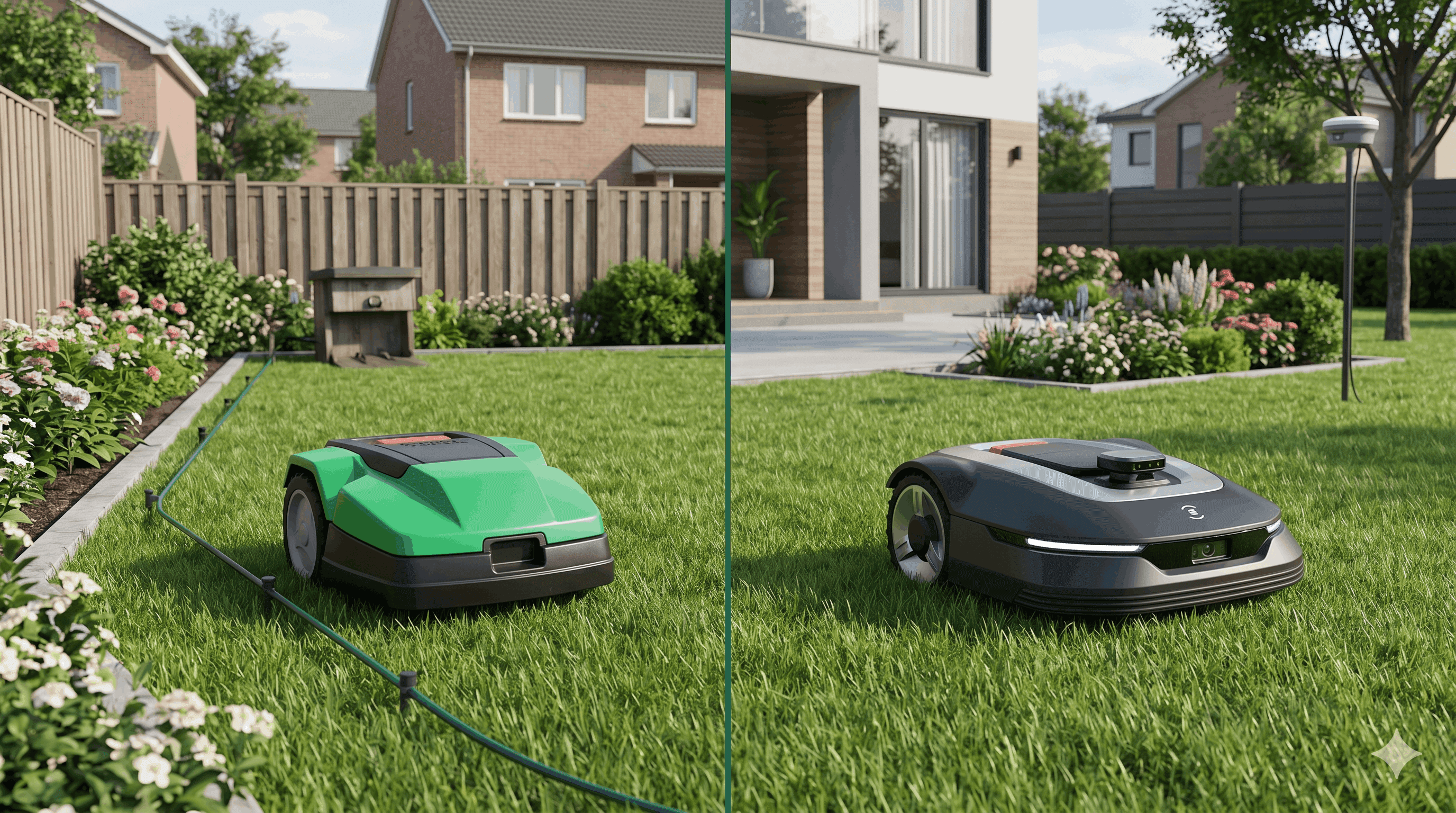
Replacing Your Boundary Wire Robot Mower with a Wire-Free Model: The Transition Guide
The installation took a full weekend and cost 200 euros. Three years later you have repaired the wire four times. Here is how to move to a wire-free model without repeating the same headache.
.png&w=3840&q=75)
May 3, 2026
Winterising and Maintenance: 5 Steps to Double the Lifespan of Your Robot Mower
Most robot mower failures do not happen during the mowing season. They happen after a bad winter storage. Here is how to avoid the most costly mistakes.