Best Robot Mowers for Large Lawns Over 2000 m² (0.5 Acre)
By Alexandre
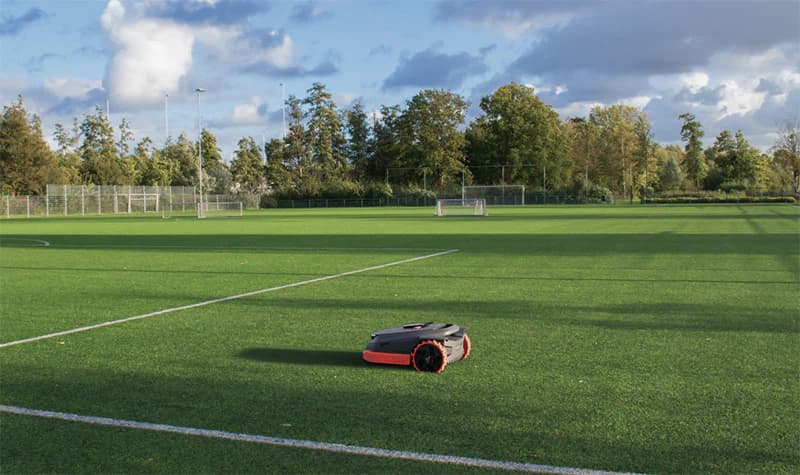
The Market's Blind Spot: The Myth of the 2000 m² Limit
If you are the lucky owner of an estate, a wooded park, or a vast country property spanning 4000 m², one hectare, or even more, you have undoubtedly noticed a frustrating trend in your research. Almost all buyer guides, simulators, and retailers focus on the "standard" suburban garden. As soon as you mention a surface area greater than 2000 m², options seem to disappear, or worse, you're advised to buy a riding lawn tractor and spend your Saturdays on it.
Yet, the automation of very large spaces is not only possible, but it is today the sector benefiting from the most spectacular technological advances. Professionals (golf courses, municipalities, sports complexes) have been using robots for years. These cutting-edge technologies are now accessible to demanding individuals.
However, mowing one hectare (10,000 m²) has nothing to do with maintaining a 500 m² patch of lawn. It's a real logistical and mechanical challenge that requires machines with industrial characteristics. Forget small entry-level robots: we are entering the category of super-sports cars and heavy-duty utilities of garden automation.
Colossal Challenges of Large Estates: What Really Changes
To understand why a robot designed for 2000 m² will fail miserably on a 6000 m² terrain, we must look at the physics and mathematics of automated mowing.
1. Coverage Speed and the Cutting Deck
Most consumer robots operate on a random movement mode (the famous "bounce" against the edges). While this system is very effective for small areas, it becomes mathematically inefficient beyond 3000 m². A random robot will spend its time going back over already mown areas and will physically not have the time (or energy) to cover the extremities of your estate before the grass has grown back too much.
For large terrains, two elements are non-negotiable:
- Systematic mowing (in parallel lines): Thanks to RTK GPS, premium robots cut the terrain into regular strips. This operating mode doubles, or even triples, the machine's surface capacity.
- An extra-wide cutting deck: A standard robot offers a cutting width of 18 to 22 cm. The giants designed for parks often sport multiple discs offering widths of 35 to over 50 cm. At each pass, it's twice as much grass cut.
2. Autonomy and Battery Thermal Management
On a small lawn, a robot will mow for an hour, then rest for an hour on its base. On a one-hectare estate, the robot must operate almost 24/7 during the strong spring growth period.
Standard Li-Ion batteries overheat when subjected to continuous charge/discharge cycles under the summer sun. High-end models for large spaces integrate superior battery chemistries, active cooling systems (internal fans), and massive capacities (often greater than 10 Ah) allowing uninterrupted mowing sessions of 4 to 6 hours.
3. Signal Range: RTK, 4G, and Wi-Fi Limits
A modern robot mower is a connected object. But how do you maintain a connection at the other end of your estate, 150 meters from your home Wi-Fi router?
This is where cellular communication modules (4G/LTE) come in. Premium models embed a SIM card (often with a subscription included for the first few years) to send their status in real-time, regardless of the size of the terrain.
Regarding navigation, RTK (Real Time Kinematic) technology is vital. It relies on satellites and a reference antenna. But beware: the radio range between the reference antenna and the robot has its limits (generally 150 to 300 meters in an open field). For very large estates or those with massive buildings, it is sometimes necessary to invest in signal repeaters or remote antennas to cover "shadow zones."
Should You Bury a Cable on a 5000 m² Terrain?
This is the big question. Historically, Husqvarna Automowers for large parks used a boundary wire.
Warning: On a one-hectare perimeter, you will need to install nearly 400 meters of cable. The slightest break due to a rodent or a spade strike will take hours to locate.
Today, for properties over 4000 m², wireless technology (RTK / LiDAR) is almost systematically recommended. The time saved during installation and the flexibility to modify mowing zones (to create a flower meadow in spring, for example) more than justify the extra cost of this technology.
Our Selection of Mowing Giants
Among the current offerings, here are the machines capable of meeting the challenge of large spaces without flinching.
The absolute reference for professionals, now accessible to individuals with large estates
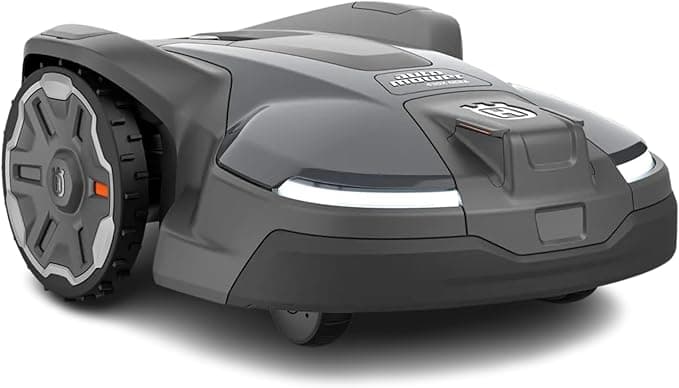
Husqvarna Automower 450X NERA
The power monster...
Affiliate link. Same price for you.
The Husqvarna Automower 450X EPOS is the flagship of the Swedish brand. Capable of managing surfaces up to 5000 m² in random mode, its EPOS wireless navigation technology allows for systematic mowing, pushing its real capacity to nearly an entire hectare depending on the complexity of the terrain. Its integrated ultrasonic radar slows the machine before impact with trees or animals, and its 4G module guarantees total control, even from the other side of the world.
Husqvarna 450X EPOS Analysis
Pros
- Proven reliability of the professional range
- Ultra-precise EPOS wireless technology
- Systematic strip mowing
- Integrated GPS anti-theft tracker and 4G module included
Cons
- Very high acquisition budget
- The reference antenna must have a perfect view of the sky
For those who own a terrain exceeding one hectare, potentially with significant slopes, the Mammotion brand offers a super-powered alternative with its Luba 2 range.
Designed for colossal terrains up to 10,000 square meters with all-wheel drive
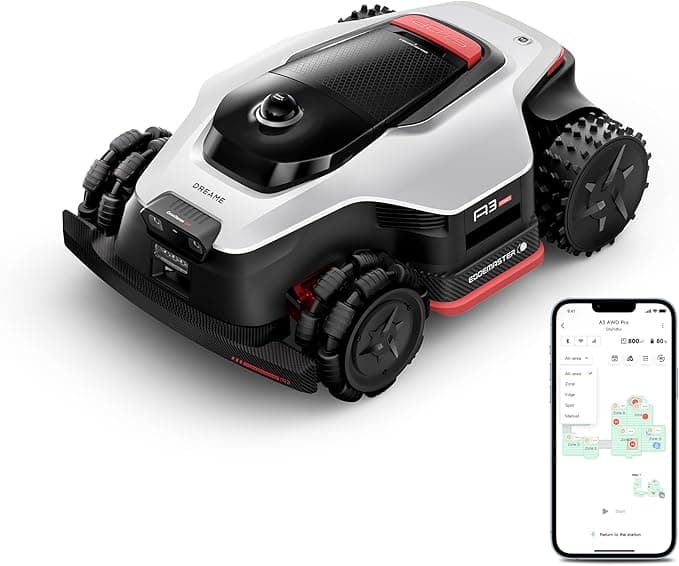
DREAME A3 AWD Pro 3500
The off-road reference for 5000m². 4-wheel drive, climbs trees (almost, 80% slope) and 3D vision.
Affiliate link. Same price for you.
The Mammotion Luba 2 AWD 10000 is a powerhouse. With its four-wheel drive and its double cutting deck totaling an impressive width of 40 cm, it swallows up hectares at a lightning speed. Its high-capacity battery gives it gigantic autonomy.
Luba 2 AWD 10000 Analysis
Pros
- Exceptional capacity up to one hectare
- Extra-wide double cutting deck
- Redoubtable 4x4 all-wheel drive
- Competitive price compared to professional models
Cons
- App still improvable compared to historical leaders
- Very heavy weight making handling complicated
A Fleet of Small Robots or a Single Giant Robot?
Faced with the prices of very high-end models, many owners of 6000 m² estates ask the question: "Shouldn't I instead buy three entry-level robots covering 2000 m² each?"
This is a technically viable strategy, called "Fleet Management."
The advantages of a fleet:
- Redundancy: If one robot is down, the other two continue working on their respective zones.
- Overall speed: Three machines mowing simultaneously offer a fast result across the entire property.
The disadvantages (and why we recommend the large format):
- Multiplied maintenance: You will have to clean three robots, change three sets of blades, and manage three charging bases (requiring power outlets distributed across the estate).
- Signal conflicts: If you use wire models, the crossed cables of multiple robots can generate interference (crosstalk).
Generally, investing in a single robust industrial machine is always more sustainable than multiplying consumer models that will wear out prematurely.
The Duel of Titans for Very Large Estates
| | |
|---|---|---|
| Max area | 5000 m² | 3500 m² |
| Max slope | 50% | 80% |
| Wire-free | ||
| GPS / RTK | ||
| Cut-to-Edge | ||
| App control | ||
| Check price | Check price |
Preparing Your Estate for Full Automation
The arrival of a machine of this caliber on your property requires meticulous preparation. A terrain of several hectares necessarily contains more traps than a small garden.
Step-by-step guide
- 1
Step 1: RTK antenna strategy
Place the reference antenna at the highest possible point, such as the roof ridge or a dedicated mast, to maximize its radio range across the entire park.
- 2
Step 2: Securing wooded zones
In dense undergrowth, the satellite signal will be lost. Create software exclusion zones for these spaces or leave them in differentiated management to promote biodiversity.
- 3
Step 3: Wildlife management
On a large estate, nocturnal wildlife is present. It is imperative to program mowing hours only during the day to protect hedgehogs and other small mammals.
- 4
Step 4: Creation of transit corridors
If your estate has several large plots separated by gravel paths or asphalt roads, configure precise transport paths in the application.
The Crucial Question of Security and Theft
Leaving a device worth several thousand dollars in total autonomy 100 meters from your house, sometimes near a shared fence or a road, is a legitimate source of anxiety.
Fortunately, robots intended for large terrains integrate military-grade security measures:
- Active Geofencing: If the robot leaves its predefined action perimeter, it locks immediately, triggers a shrill alarm, and sends you an instant push notification.
- Integrated GPS Tracker: Premium models have an independent GPS module with a backup battery. Even if the thief removes the main battery, the chip continues to emit its exact position to law enforcement.
- PIN Code and Network Pairing: The robot is coupled to its antenna and your cloud account. It is strictly unusable outside of this ecosystem, making it useless on the black market.
Frequently Asked Questions (FAQ) - Large Terrain Special
Frequently Asked Questions
How long does it take for a premium robot to mow 5000 square meters?
Do the wheels damage the lawn on long trips back to the base?
What to do with the cut grass on such a large surface?
Should the charging station be protected from the elements?
Conclusion: The Ultimate investment for Your Estate
Buying a robot mower for a very large terrain represents a significant financial investment, often comparable to buying a very good riding lawn tractor. However, the return on investment is incomparable.
You don't just get a perfectly mown lawn, worthy of a golf green across your entire property: you get your time back. The infinite hours spent sitting on a noisy tractor, breathing in exhaust fumes, are replaced by silent, ecological, and totally autonomous management of your landscape.
For exceptional properties, the premium robot mower is no longer a gadget, it's the most powerful home automation management tool for your estate.
Ready to automate your estate?
Use our terrain analysis tool to identify the machine capable of covering your plot and calculate the time saved each season
Read also
.png&w=3840&q=75)
May 19, 2026
Small Urban Gardens: Which Wire-Free Robot Mower to Choose in 2026?
High walls, narrow paths, and a patio taking up half the garden. Urban lawns are the hardest terrain for robot mowers. Here is which navigation technology actually works when the sky is blocked.
May 5, 2026
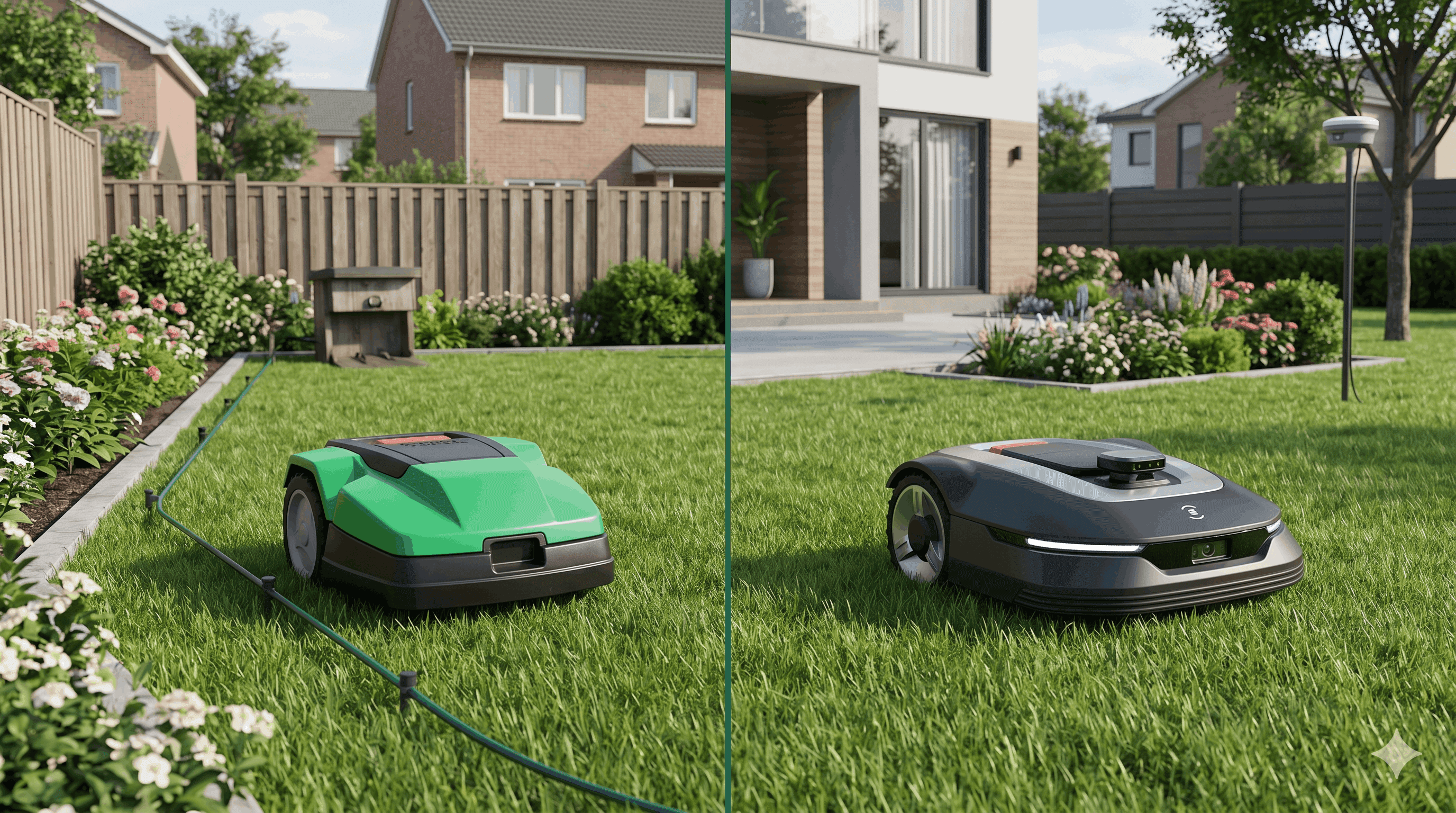
Replacing Your Boundary Wire Robot Mower with a Wire-Free Model: The Transition Guide
The installation took a full weekend and cost 200 euros. Three years later you have repaired the wire four times. Here is how to move to a wire-free model without repeating the same headache.
.png&w=3840&q=75)
May 3, 2026
Winterising and Maintenance: 5 Steps to Double the Lifespan of Your Robot Mower
Most robot mower failures do not happen during the mowing season. They happen after a bad winter storage. Here is how to avoid the most costly mistakes.