Robot Mower and Separate Zones: The Complete Installation Guide
By Le Coin Vert
.png&w=3840&q=75)
Introduction: The challenge of fragmented lawns
This is undoubtedly the question that comes up most often in our mailbag at Le Coin Vert: "I have a beautiful lawn in front of my house and another in the back, but they are irremediably separated by a gravel path or a terrace. Am I condemned to buy two robots?"
Rest assured immediately, the answer is no. In 2026, automated mowing technologies have evolved significantly to meet these topographical challenges. However, the technical solution to adopt will intimately depend on the configuration of your separation zone.
Let's explore together the proven strategies for managing these famous "secondary zones," from the traditional manual method to the latest satellite navigation innovations.
Assessing the nature of the separation
Before choosing a model or pulling any cable, it is crucial to analyze the obstacle that separates your grassed zones.
Step-by-step guide
- 1
Step 1: Observe the leveling
Check if your two zones are on the same level. An incline greater than 15% or the presence of steps blocks classic autonomous navigation.
- 2
Step 2: Analyze the surface
An asphalt or smooth paved path is traversable. Deep gravel will trap your robot's small wheels.
- 3
Step 3: Measure the distance
A two-meter passage can be managed with a wire, but a distance of 50 meters will require wireless technology.
Strategy 1: The manual method (Secondary Zone Mode)
This solution applies only if your two zones are separated by impassable obstacles: a three-step staircase, a low wall, or a hermetic fence.
An uninterrupted electrical loop
You must encircle the second zone with the same boundary wire as the main zone. The loop must be continuous: the wire starts from the base, delimits the main zone, crosses the obstacle (in the joint of a terrace or along a plinth), goes around the isolated zone, and returns to its starting point.
Warning: Ensure that the two wires crossing the obstacle are laid strictly parallel and very close together to cancel the signal in this transit zone.
Daily human intervention
You must physically carry the robot to the secondary zone, select "Manual Mow" mode, and start it. It will work until its battery is exhausted. A viable solution for 50m², but tedious beyond that.

Worx Landroid S300 (WR130E)
The smart choice for small gardens...
- Very compact, affordable, uses the universal Worx PowerShare 20V battery.
- Boundary wire installation required, no control display on the mower, strictly for very small yards.
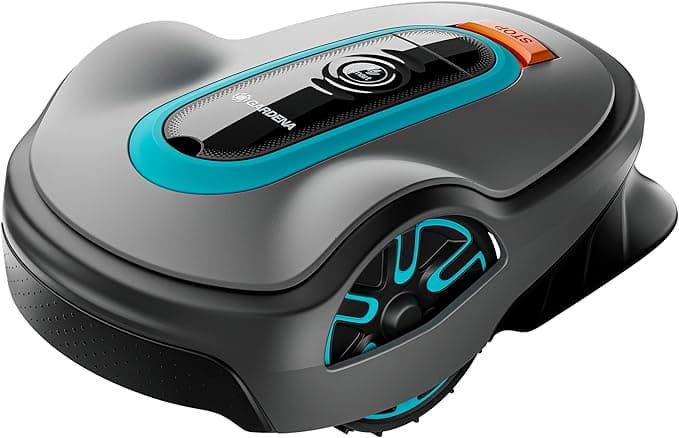
Gardena Smart SILENO Life 750
German excellence...
- Ultra-quiet operation (57 dB(A))
- easily navigates narrow passages (CorridorCut)
- +1 more
- Requires the installation of both a boundary wire AND a guide wire.
Strategy 2: Total automation via a passage corridor
If your two zones are at the same level, separated by a path or smooth slabs, total automation is possible. The secret: a guide wire that crosses the path and serves as an invisible rail for the robot.
Info: For this method to work, ensure that your passage corridor has a minimum width of 60 cm between the boundary wires.
The absolute reference for navigating narrow corridors thanks to its systematic guide wire
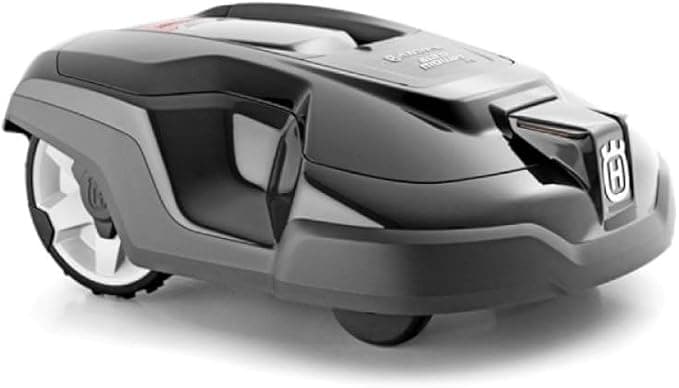
Husqvarna Automower 315 Mark II
Increased capacity for 1500m²...
- Weather timer adjusts mowing to grass growth, frost sensor, excellent durability.
- Bluetooth connectivity (Connect@Home) has limited range, wired installation.
Affiliate link. Same price for you.
The Husqvarna Automower 315 is particularly recommended for this exercise. It perfectly manages the passage in narrow corridors and avoids repetitive wheel tracks.
Strategy 3: The revolution of wireless robots (RTK and Vision)
If the distance between your two zones is very significant or if the intermediate terrain is impossible to wire, RTK or vision robots define virtual "transport zones" from the mobile app. The robot crosses the path with blades stopped.
Comparison of wireless solutions for multiple zones
 |  | |
|---|---|---|
| Max area | 500 m² | 2000 m² |
| Max slope | 30% | 45% |
| Wire-free | ||
| GPS / RTK | ||
| Cut-to-Edge | ||
| App control | ||
| Check price | Check price |
RTK / Vision Technology
Pros
- No wires to bury
- Unlimited transit zones
- Blades stopped during the trip
Cons
- Higher budget
- Requires a clear view of the sky for GPS
The visual alternative
If your terrain has many trees or buildings blocking the GPS signal, LiDAR or vision robots like the Dreame A1 Pro navigate from one lawn to another by "seeing" their environment in real-time.
Don't forget peripheral home automation
A robot navigating between two zones must contend with automatic watering. A connected controller like the Gardena Smart Water Control or a Shelly module automatically cuts the watering of the secondary zone when the robot starts its transit.
In summary: Which choice for your garden?
If you can create a flat passage at least 60 cm wide, automation is within reach with a well-configured wired model. Otherwise, RTK wireless technology is now mature enough to meet your expectations.
Frequently Asked Questions
Can my wired robot cross a gravel path?
Can RTK robots manage more than two zones?
Need help choosing the right technology?
Our free simulator in 3 clicks finds the ideal robot for your different lawn zones.
Read also
.png&w=3840&q=75)
May 19, 2026
Small Urban Gardens: Which Wire-Free Robot Mower to Choose in 2026?
High walls, narrow paths, and a patio taking up half the garden. Urban lawns are the hardest terrain for robot mowers. Here is which navigation technology actually works when the sky is blocked.
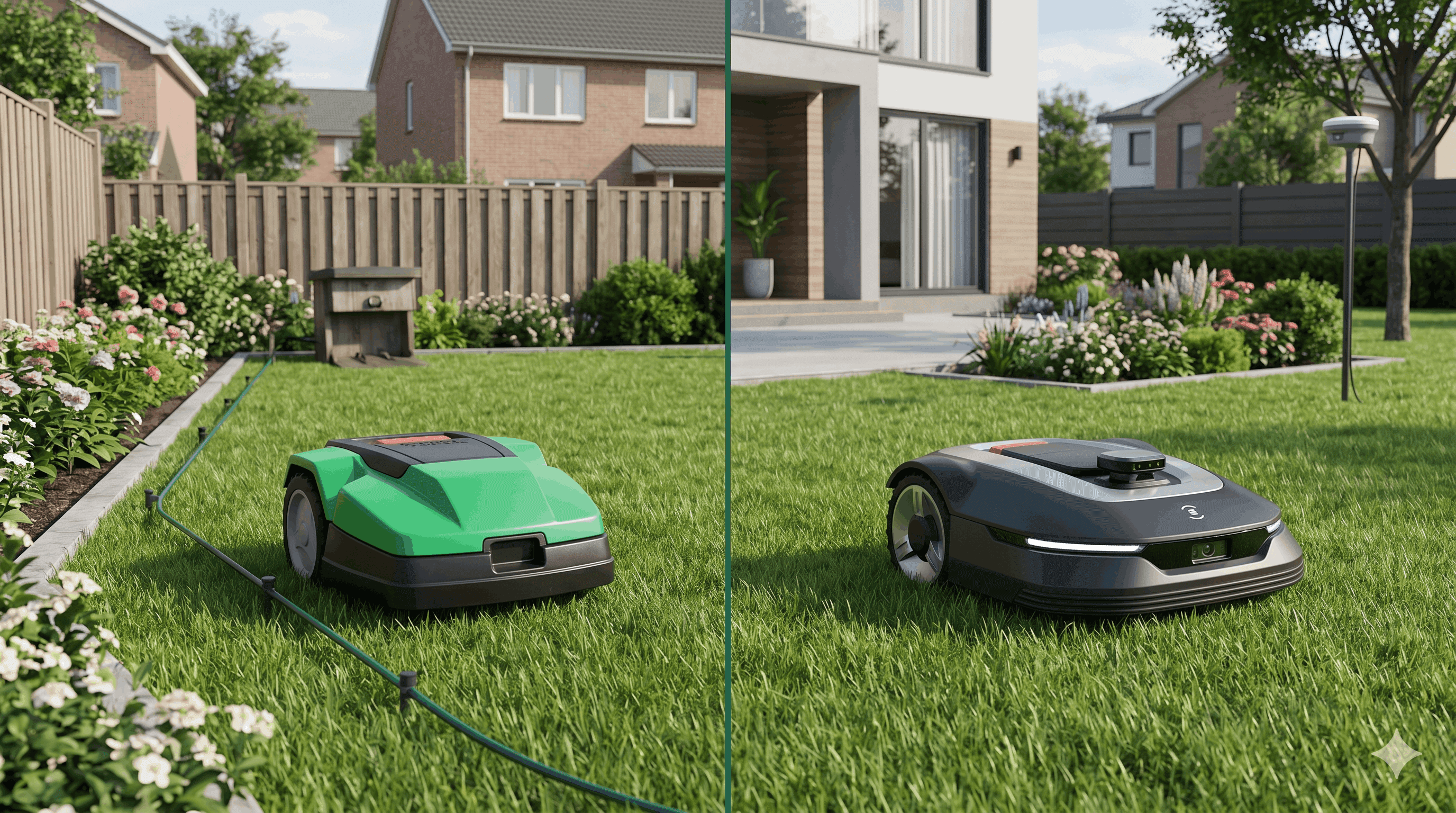
May 5, 2026
Replacing Your Boundary Wire Robot Mower with a Wire-Free Model: The Transition Guide
The installation took a full weekend and cost 200 euros. Three years later you have repaired the wire four times. Here is how to move to a wire-free model without repeating the same headache.
.png&w=3840&q=75)
May 3, 2026
Winterising and Maintenance: 5 Steps to Double the Lifespan of Your Robot Mower
Most robot mower failures do not happen during the mowing season. They happen after a bad winter storage. Here is how to avoid the most costly mistakes.