RTK vs. LiDAR vs. Vision: The Ultimate Guide to Never Losing GPS Signal
By Alexandre
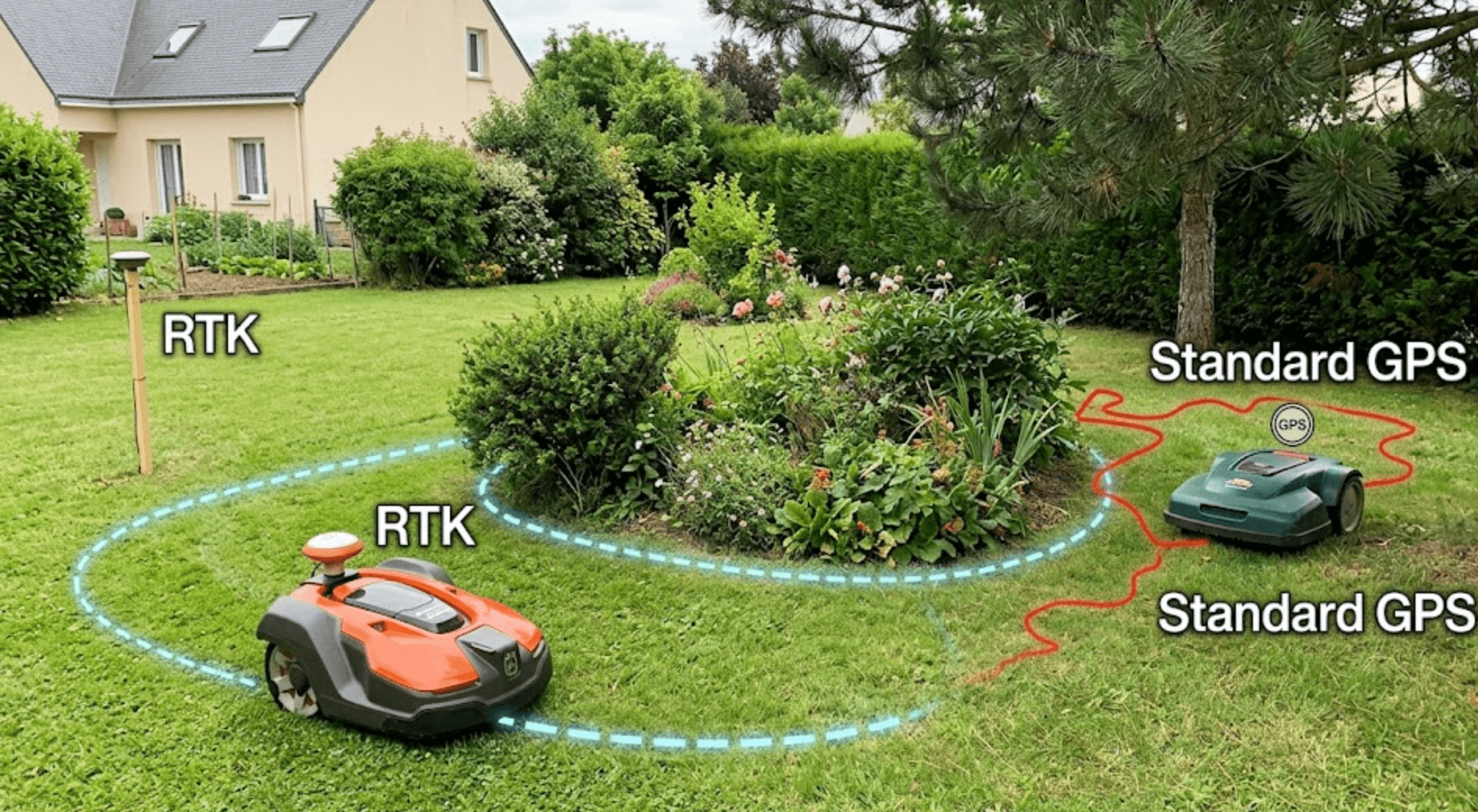
Automated green space maintenance is undergoing an unprecedented technological transformation in 2026. The removal of the boundary wire, once a necessary step and source of recurring failures, has paved the way for navigation systems with sophistication worthy of the autonomous automotive industry.
However, replacing a physical constraint with invisible signals transfers the complexity to the choice of the technology itself. For complex, wooded, or urban terrains, acquiring a robot mower is no longer a simple question of cutting surface or battery capacity. The real question lies in the onboard processor's ability to interpret its physical environment when primary landmarks disappear.
This exhaustive analysis decrypts the mechanisms of RTK, LiDAR, and AI Vision (vSLAM), identifying the specific pains related to signal loss and proposing strategic recommendations to dominate the smart gardening niche.
The Challenge of Complex Gardens: Physical Limits of Standard Navigation
The residential garden ecosystem is particularly hostile to navigation signals. Unlike vast open agricultural plots where satellite positioning excels, private grounds are dotted with dynamic and static obstacles that alter wave propagation.
The Masking Effect (Canopy) and L-Band Attenuation
The classic GNSS system (exploiting GPS, Galileo, GLONASS, and BeiDou constellations) uses L-band radio waves. These signals, emitted from space, are extremely weak when they reach Earth. When a garden has a high density of deciduous or evergreen trees, the "canopy" acts as an absorbent filter.
Leaves, particularly when saturated with water after a downpour or covered with dew, absorb and diffract the radio signal. Under a hundred-year-old oak, a robot mower losing its direct line of sight with the sky will see its accuracy instantly drop from a few centimeters to an uncertainty radius of several meters, triggering the device's safety stop.
The Multipath Effect in Urban Environments
The second enemy of satellite navigation is the "multipath" effect. In gardens bordered by bay windows, verandas, metal fences, or high concrete walls, the satellite signal bounces off these reflective surfaces before reaching the robot's receiver.
The receiver calculates distance based on the signal's time of flight; a reflected signal that has traveled a longer distance misleads the system. The robot then interprets its position as being offset by several meters, which triggers a "Virtual zone exit" (out of bounds) alert and immobilizes the unit.
Anatomy and Decrypting Positioning Technologies
Faced with these physical limits, robotic engineering proposes three major paradigms, often used in isolation on entry-level models, and fused on high-end equipment.
1. The RTK (Real-Time Kinematic) System: Precision by Differential Correction
Real-time kinematic positioning (RTK) marked the first true "wireless" revolution. It relies on comparing the phase of the satellite signal carrier waves between two receivers: a fixed base station (whose coordinates are known with absolute precision) and a mobile receiver onboard the robot.
The fixed base picks up satellite signals, calculates the error induced by ionospheric and tropospheric disturbances, and transmits an ultra-fast correction signal (often via LoRa radio waves) to the robot. The ideal investment for very large open grounds relies on this technology.
2. 3D LiDAR: Independence through Laser Mapping
To compensate for satellite signal deficiencies, LiDAR (Light Detection and Ranging) technology is becoming essential. This system emits infrared laser pulses and measures the time of flight (Time-of-Flight) to create an ultra-dense 3D point cloud of the environment, without depending on any external signal.
The best choice for heavily wooded terrain
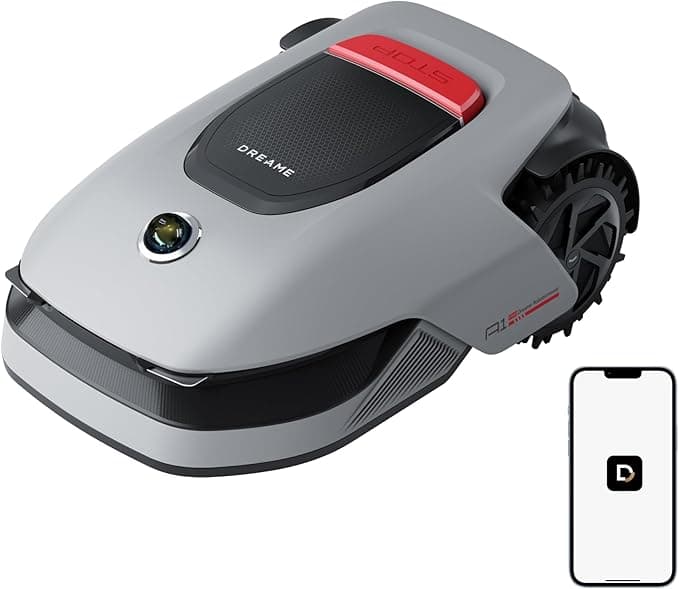
Dreame A1 Pro LiDAR
Precise 3D LiDAR navigation...
- Ultra-precise OmniSense LiDAR navigation (works without GPS or light)
- fast 3D mapping
- sleek design.
- The top-mounted LiDAR dome is exposed to very low-hanging branches
- premium price tag.
Affiliate link. Same price for you.
The OmniSense 3D system of the Dreame A1 Pro completely frees itself from GPS, allowing mapping of complex terrain in just 15 minutes, while navigating serenely under the densest shade.
3. AI Vision (vSLAM): Dynamic Pixel Analysis
The vSLAM (Visual Simultaneous Localization and Mapping) system gives the robot true ocular perception. Using high-resolution cameras coupled with neural networks, the robot extracts visual landmarks from its environment to triangulate its position.
The supreme advantage of Vision lies in its semantic classification capability. Unlike LiDAR which detects a physical obstacle without knowing its nature, Artificial Intelligence specifically identifies if it is a toy, a garden hose, or a pet, dynamically adapting its safety distance.
Sensor Fusion: The Ultimate Navigational Architecture
Technical analysis proves that no single sensor can solve 100% of complex garden scenarios. The industry is therefore moving towards Sensor Fusion, unifying the strengths of each technology to mitigate their respective weaknesses.
The Tri-Fusion Ecosystem: Mammotion Supremacy
The Tri-Fusion system, introduced on the Mammotion range (notably the Luba 2 series), simultaneously integrates LiDAR, RTK, and AI Vision. The onboard computing power allows for "Dynamic Sensor Switching":
- Open Space: RTK pilots for maximum efficiency.
- Under an Imposing Oak: 3D LiDAR takes over to maintain millimeter mapping.
- Facing a Moving Object: AI Vision intervenes for intelligent avoidance.
C-PASS Integration (vSLAM + INS): RoboUP Resilience
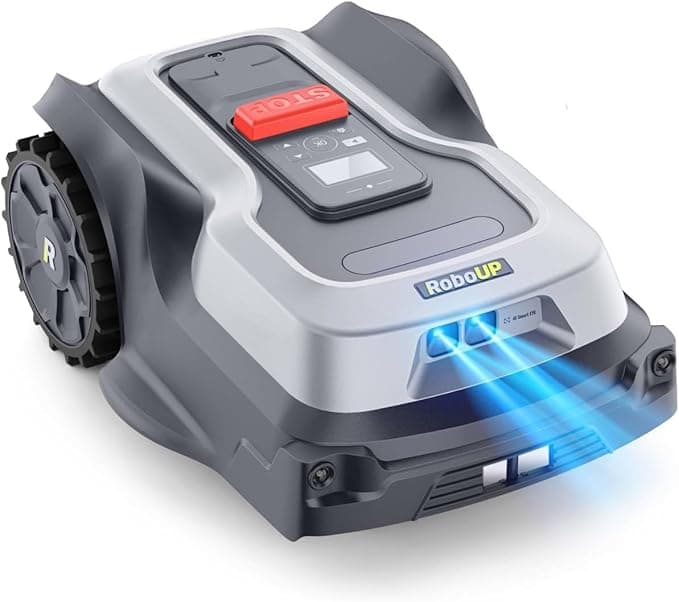
The C-PASS system developed for the RoboUP T1200 Pro merges RTK, vSLAM, and an Inertial Navigation System (INS). The INS, composed of accelerometers and gyroscopes, allows for dead reckoning navigation. During a total loss of external signals, the robot maintains perfectly parallel mowing lines.
2026 Navigation Technology Comparison
|  |  |  |  | |
|---|---|---|---|---|---|
| Max area | 2000 m² | 500 m² | 2000 m² | 3500 m² | 1200 m² |
| Max slope | 45% | 30% | 45% | 80% | 45% |
| Wire-free | |||||
| GPS / RTK | |||||
| Cut-to-Edge | |||||
| App control | |||||
| Check price | Check price | Check price | Check price | Check price |
Equipment Strategy and Targeted Recommendations
Equipment selection requires a perfect match with the site topology. The following models have been rigorously selected to address the documented technological "pains."
The LiDAR Choice for Tree Complexity
The Dreame A1 Pro is a mapping feat. Devoid of a remote antenna, its installation is limited to positioning the charging station. Its LiDAR sensor draws a multi-zone map in record time. It is the definitive solution against the canopy effect.
All-Wheel Drive for Rugged Topographies
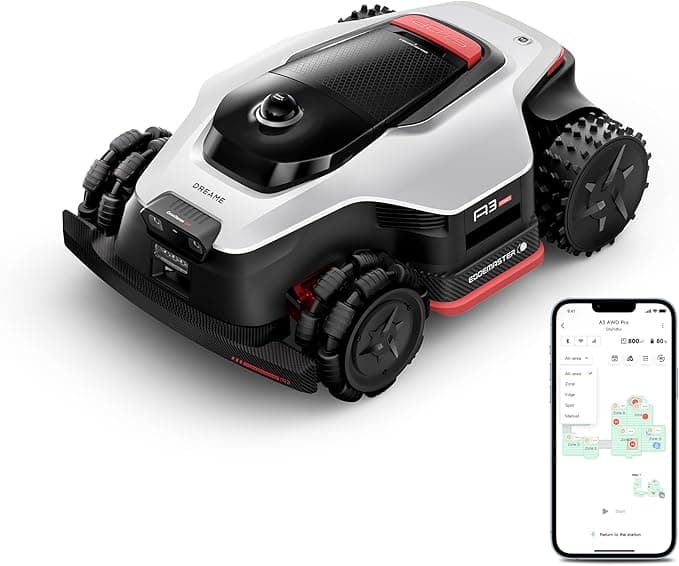
The Mammotion Luba 2 AWD stands out thanks to its all-wheel drive (AWD). Capable of climbing extreme slopes (up to 80%), it combines mechanical robustness with sharp navigation intelligence.
Brute power for rugged estates
DREAME A3 AWD Pro 3500
The off-road reference for 5000m². 4-wheel drive, climbs trees (almost, 80% slope) and 3D vision.
Affiliate link. Same price for you.
Urban Excellence and Installation Simplicity
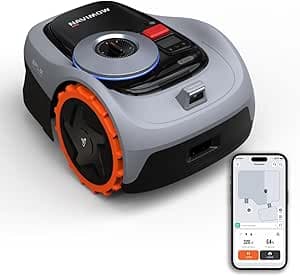
For a classic residential garden, the Segway Navimow i105E represents the expert entry level. It is distinguished by the integration of EFLS 2.0 and its 140° VisionFence camera.
The best price/performance ratio for wireless urban gardens
Segway Navimow i105E
The affordable wireless revolution...
- Easy wire-free setup via app
- AI camera for obstacle avoidance
- excellent multi-zone management.
- Requires a relatively clear sky view for GPS (RTK) signal
- capacity limited to 500m² yards.
Affiliate link. Same price for you.
Quad-Camera Innovation
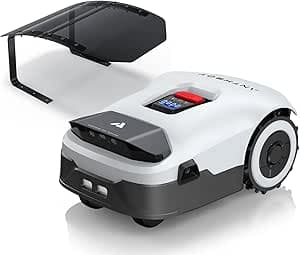
The approach of the Anthbot Genie 1000 is unique. By combining four cameras offering a 300° field of view with an RTK receiver analyzing 155 satellites, this robot guarantees flawless environmental safety.
Pickup Bonus
The Mammotion YUKA deserves special mention. It transcends the simple mowing function thanks to its optional sweeper kit, capable of collecting dead leaves and plant debris.
Technical Installation and Optimization Guide
Deploying an RTK solution requires scientific rigor to avoid positioning errors (multipath and masking).
- Horizon Evaluation: The reference antenna must benefit from a clear visibility cone of 120 degrees minimum towards the celestial vault.
- Interference Avoidance: The antenna must be at least two meters away from metal walls, bay windows, and reflective roofs.
- Elevation: Using extension kits to fix the antenna at the top of the roof is often indispensable to overcome the canopy effect.
- Signal Validation: A stabilized signal (often indicated in green or "Fix") must be maintained for at least 15 minutes before mapping.
Garden Home Automation: Synergy between Mowing and Watering
Modern technological expertise no longer conceives of garden maintenance in silos. Integration via Home Assistant allows for creating true environmental intelligence.
Adaptive Automation Script (Home Assistant Example)
The following YAML script illustrates a preservation logic: it prohibits robot mower deployment if the soil is too wet and only activates watering if precipitation is absent.
unknown nodePreventive Maintenance and Sensor Longevity
Long-term reliability of fusion systems depends on meticulous maintenance. Detection components (AI cameras, LiDAR domes) constitute the nervous system of these machines.
- Bi-monthly Cleaning: Use a soft microfiber cloth and clear water for lenses and domes. Prohibit abrasive detergents.
- Winter Storage: Store the robot in a dry and temperate place to preserve the battery.
- Sharp Blades: Replace blades every 8 weeks to minimize harmful vibrations to internal sensors (INS).
Frequently Asked Questions
Why does my RTK robot stop under trees?
Are LiDAR systems sensitive to rain?
Is it possible to map at night with AI cameras?
The landscape of green space maintenance has passed a definitive milestone. Understanding the physical mechanisms that govern satellite waves, lasers, and pixel analysis allows for moving towards resilient and high-performing solutions.
Not sure of the model?
Our simulator guides you to choose between RTK, LiDAR, and Vision.
Read also
.png&w=3840&q=75)
May 19, 2026
Small Urban Gardens: Which Wire-Free Robot Mower to Choose in 2026?
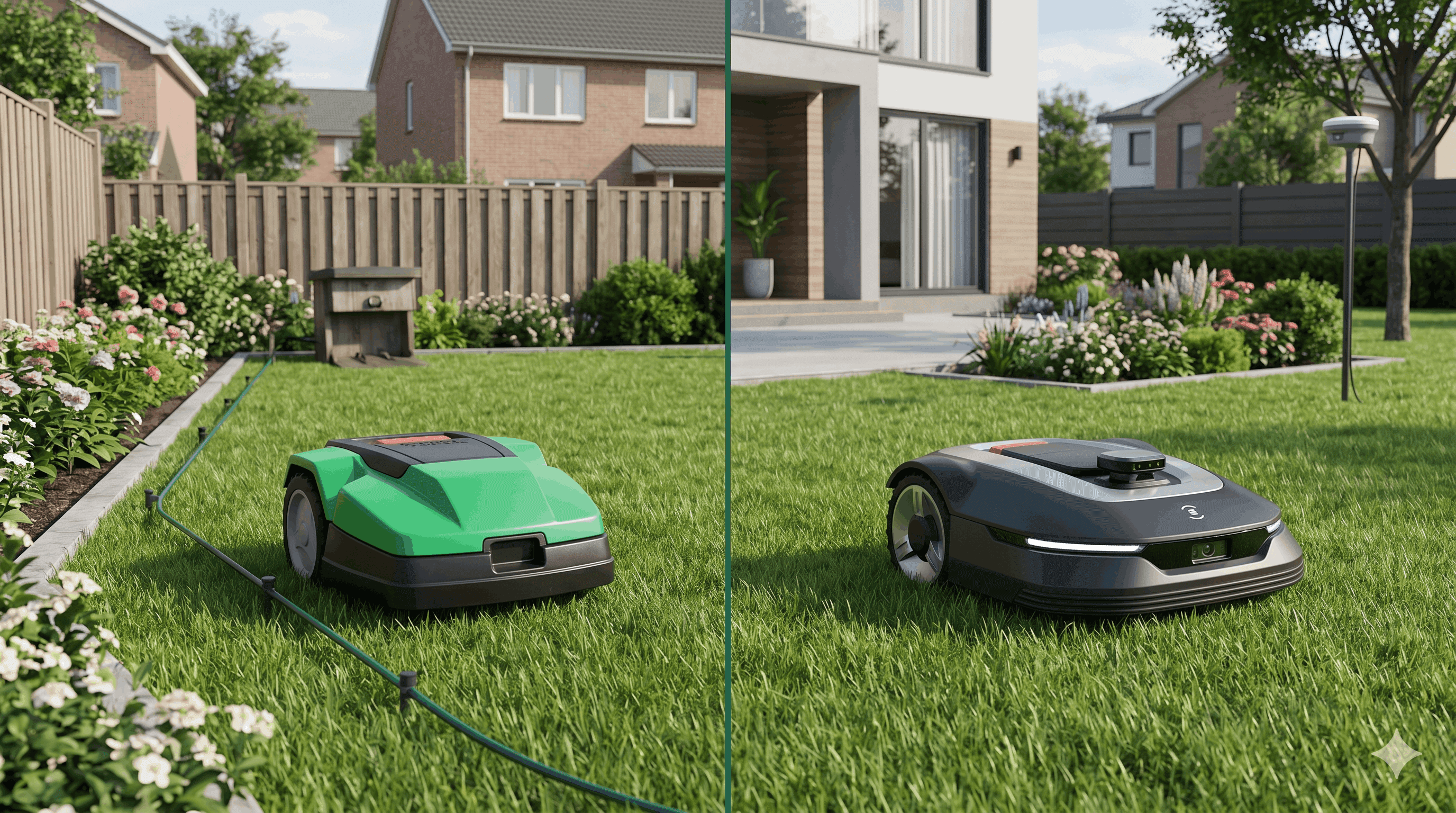
High walls, narrow paths, and a patio taking up half the garden. Urban lawns are the hardest terrain for robot mowers. Here is which navigation technology actually works when the sky is blocked.
May 5, 2026
Replacing Your Boundary Wire Robot Mower with a Wire-Free Model: The Transition Guide
The installation took a full weekend and cost 200 euros. Three years later you have repaired the wire four times. Here is how to move to a wire-free model without repeating the same headache.
.png&w=3840&q=75)
May 3, 2026
Winterising and Maintenance: 5 Steps to Double the Lifespan of Your Robot Mower
Most robot mower failures do not happen during the mowing season. They happen after a bad winter storage. Here is how to avoid the most costly mistakes.